What Caused the Deadly Mosque Blast in Syria During Friday Prayers?
Published: 2025-12-26 16:00:17 | Category: world
An explosion during Friday prayers at the Imam Ali ibn Abi Talib Mosque in Homs, Syria, has tragically resulted in at least eight deaths and injuries to 18 others. This devastating incident highlights the ongoing violence in the region, with the jihadist group Saraya Ansar al-Sunnah claiming responsibility for the attack, which authorities believe involved explosives detonated inside the mosque.
Last updated: 27 October 2023 (BST)
What’s happening now
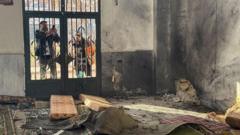
On 27 October 2023, an explosion rocked the Imam Ali ibn Abi Talib Mosque in Homs, causing significant casualties during a time of communal prayer. The Syrian health ministry confirmed that at least eight individuals lost their lives and 18 others sustained injuries as a result of the blast. Eyewitness accounts and images from the state-run news agency, Sana, depict a scene of chaos, with charred walls, shattered windows, and bloodstained carpets inside the mosque.
The Syrian Foreign Ministry has condemned the incident as a "terrorist crime," asserting that it undermines both security and moral values in the nation. Officials are currently investigating the attack, with a focus on identifying the perpetrators as well as the motive behind this violent act.
Key takeaways
- At least eight people have died and 18 others have been injured following an explosion in a mosque in Homs.
- The jihadist group Saraya Ansar al-Sunnah has claimed responsibility for the attack.
- The explosion is seen as part of ongoing sectarian violence in Syria, particularly against the Alawite community.
Timeline: how we got here
The events leading to the explosion are marked by a complex history of sectarian conflict and violence in Syria. Below is a brief timeline of significant events:
- March 2021: Security forces reportedly killed dozens of Alawites in Latakia, exacerbating tensions in the region.
- June 2023: Saraya Ansar al-Sunnah first gained attention after claiming responsibility for a church bombing in Damascus.
- 27 October 2023: The explosion during Friday prayers at the Imam Ali ibn Abi Talib Mosque occurs, leading to multiple fatalities and injuries.
What’s new vs what’s known
New today/this week
The claim of responsibility by Saraya Ansar al-Sunnah marks a significant development in the context of ongoing sectarian violence in Syria. The group stated that the attack was executed in collaboration with another unidentified faction, using explosives planted within the mosque itself.
What was already established
Prior to this incident, Saraya Ansar al-Sunnah had been largely inactive for several months, with its previous activities focusing on targeted killings of minority groups and governmental figures associated with the former regime of Bashar al-Assad. The recent claim of responsibility raises questions regarding the group’s motives and affiliations, particularly given its vague origins and potential connections to Islamic State (IS).
Impact for the UK
Consumers and households
While the immediate impact of the explosion in Homs is felt within Syria, UK residents may also experience indirect effects, particularly in relation to humanitarian aid and refugee support. The ongoing violence can lead to increased numbers seeking asylum in the UK, as well as heightened calls for international intervention.
Businesses and jobs
The ongoing instability in Syria hampers the potential for economic recovery. Businesses operating in or with connections to the region face significant risks, including supply chain disruptions and increased operational costs due to heightened security measures.
Policy and regulation
The UK government’s position on Syria may evolve in response to the recent violence. Policymakers could consider reviewing humanitarian aid strategies and refugee policies as the situation develops and the implications for regional stability become clearer.
Numbers that matter
- 8: The number of confirmed fatalities from the explosion in Homs.
- 18: The number of individuals reported injured as a result of the blast.
- 1: The number of jihadist groups claiming responsibility for the attack, Saraya Ansar al-Sunnah.
Definitions and jargon buster
- Alawite: An ethnoreligious group in Syria, primarily associated with Shia Islam.
- Jihadist: Refers to individuals or groups that advocate for or engage in violent struggle, often under the guise of religious motivations.
- Sectarian violence: Conflict arising from divisions between different religious or ethnic groups.
How to think about the next steps
Near term (0–4 weeks)
In the immediate aftermath of the explosion, authorities will likely focus on identifying the perpetrators and assessing the security situation in Homs and surrounding areas. Increased security measures may be implemented in mosques and other religious sites.
Medium term (1–6 months)
As investigations proceed, the international community may increase pressure on the Syrian government to address sectarian violence. Humanitarian organisations might ramp up efforts to provide support to those affected by ongoing violence, particularly in minority communities.
Signals to watch
- Any further claims of responsibility from Saraya Ansar al-Sunnah or similar groups.
- Changes in the security situation in Homs and surrounding regions.
- Reactions from the Syrian government and international bodies to the attack.
Practical guidance
Do
- Stay informed about ongoing developments in Syria, particularly regarding security and humanitarian efforts.
- Support charities and organisations working to aid refugees and those affected by the conflict.
Don’t
- Ignore the potential for increased sectarian tensions that may arise from such attacks.
- Assume that the situation in Syria is static; it is frequently evolving.
Checklist
- Monitor news sources for updates on the situation in Syria.
- Consider supporting reputable humanitarian organisations focused on Syrian relief efforts.
- Engage with community discussions regarding the implications of sectarian violence.
Risks, caveats, and uncertainties
As the situation develops, several uncertainties remain regarding the true affiliations and motivations of Saraya Ansar al-Sunnah. Observers have raised concerns about the potential for this group to be a front for larger jihadist organisations like Islamic State. Moreover, the security landscape in Syria is highly volatile, and the risk of further attacks remains significant, particularly against minority communities. It is essential for analysts and policymakers to remain vigilant and responsive to these evolving threats.
Bottom line
The explosion at the mosque in Homs underscores the persistent sectarian violence in Syria, with deadly implications for minority communities, particularly Alawites. As the investigation unfolds, the international community must remain alert to the ramifications of such attacks, both for regional stability and humanitarian efforts. Addressing the underlying issues and supporting those affected remains crucial in the wake of this tragedy.
FAQs
What caused the explosion in Homs?
The explosion in Homs was caused by explosives detonated inside the Imam Ali ibn Abi Talib Mosque during Friday prayers, reportedly claimed by the jihadist group Saraya Ansar al-Sunnah.
How many people were affected by the blast?
At least eight individuals lost their lives, and 18 others were injured as a result of the explosion at the mosque.
What is the significance of Saraya Ansar al-Sunnah?
Saraya Ansar al-Sunnah is a jihadist group that has recently claimed responsibility for attacks in Syria, raising concerns about its connections to larger extremist organisations and the implications for sectarian violence in the region.