Will NASA Astronauts' Moon Mission Face Delays Due to Rocket Problems?
Published: 2026-02-21 19:00:09 | Category: technology
The Artemis II mission, NASA's highly anticipated lunar mission, is facing potential delays due to technical issues identified during safety checks, specifically concerning helium flow. Originally slated for a launch window starting 6 March 2024, NASA now indicates that this timeline is "almost assuredly" impacted, which could push back humanity's return to the Moon after 50 years.
Last updated: 02 March 2024 (BST)
What’s happening now
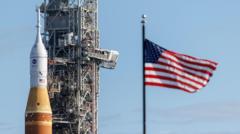
NASA's Artemis II mission, which aims to send astronauts around the Moon, has encountered a significant setback due to an interruption in the helium flow necessary for launch operations. This issue came to light following a recent test involving the fuelling of the Space Launch System (SLS) rocket. While the initial simulation revealed no faults, subsequent checks indicated a problem with the helium system, which is critical for pressurising fuel tanks and cooling rocket components. As a result, the planned launch on 6 March 2024 is now in jeopardy, with NASA officials confirming that the delay is almost certain.
Key takeaways
- The Artemis II mission is likely to be delayed due to helium flow issues.
- The launch window originally set for 6 March 2024 is now in question.
- This mission would mark the first crewed lunar flight in 50 years.
- Four astronauts are prepared for a 10-day journey to the Moon's far side.
- A successful Artemis II mission could pave the way for Artemis III, aiming for a Moon landing by 2028.
Timeline: how we got here
Understanding the timeline of the Artemis II mission provides context for the current situation:
- August 2022: NASA's Artemis I mission successfully completes an uncrewed lunar flight, paving the way for future crewed missions.
- February 2024: NASA conducts a simulation test at the Kennedy Space Center, preparing for the Artemis II launch.
- 6 March 2024: Initial launch date for Artemis II, now in doubt due to helium flow issues.
- Beyond 2024: A successful Artemis II mission could lead to Artemis III, potentially landing astronauts on the Moon by 2028.
What’s new vs what’s known
New today/this week
Nasa has confirmed that an issue with the helium flow has arisen, which is critical for the launch operations of Artemis II. This development introduces uncertainty around the planned launch window, initially aimed for early March 2024.
What was already established
Prior to this incident, the Artemis II mission was considered a significant milestone in NASA's lunar exploration efforts, with astronauts set to embark on a 10-day mission to orbit the Moon. The mission is seen as a precursor to Artemis III, which aims to land astronauts on the lunar surface.
Impact for the UK
Consumers and households
While the direct impact on UK households may be limited, the Artemis II mission represents a significant milestone in space exploration that captures public interest. Delays could influence the global space agenda, including collaborations with UK space agencies and industries involved in space technology and research.
Businesses and jobs
The aerospace sector in the UK could face indirect implications due to the delay of Artemis II. Companies involved in supplying parts or technologies for space missions may experience shifts in timelines or contracts based on the mission's progress.
Policy and regulation
Should delays continue, UK governmental and space policy discussions could evolve, particularly regarding investment in space exploration and technologies. The UK has been keen to align with international partners in advancing space missions, which could be influenced by the outcome of Artemis II.
Numbers that matter
- 730,000 gallons: Amount of propellant used during the Artemis II rocket fuelling simulation.
- 50 years: Duration since humans last set foot on the Moon, with Artemis II aiming to change that.
- 10 days: Duration of the planned Artemis II mission to the Moon and back.
- 4 astronauts: Crew members, including three from the US and one from Canada, preparing for the mission.
- 2028: Target year for Artemis III, which aims to land astronauts on the Moon.
Definitions and jargon buster
- Artemis II: NASA's planned crewed mission to orbit the Moon.
- Helium flow: The movement of helium gas used to pressurise rocket fuel tanks.
- Space Launch System (SLS): NASA's rocket designed for deep-space missions.
- Kennedy Space Center: NASA's primary launch centre located in Florida.
How to think about the next steps
Near term (0–4 weeks)
In the immediate future, NASA will be focused on resolving the helium flow issue. Engineers will conduct thorough assessments and simulations to ensure the integrity of the system before rescheduling the launch.
Medium term (1–6 months)
If the helium flow problem is resolved quickly, NASA may still aim to launch Artemis II within the next few months. However, if complications arise, the timeline for subsequent Artemis missions may also need to be reassessed.
Signals to watch
- Updates from NASA regarding the resolution of the helium flow issue.
- Potential changes to the launch date and mission objectives.
- Public announcements regarding Artemis III and its planned developments.
Practical guidance
Do
- Stay informed about NASA's updates on the Artemis II mission.
- Engage with educational resources on space exploration to better understand the implications of these missions.
- Follow news regarding the UK’s role and participation in international space missions.
Don’t
- Assume the March launch window is guaranteed; delays are likely.
- Neglect the importance of technical issues in space missions; they are critical to ensuring safety.
- Overlook the broader implications of space missions on technology and international collaboration.
Checklist
- Check NASA's official channels for the latest updates on the Artemis II mission.
- Monitor news related to the UK space sector and potential collaborations.
- Consider how advancements in space exploration might affect related industries in the UK.
- Engage in discussions about the importance of technical readiness for space missions.
- Stay aware of public engagement opportunities related to the Artemis programme.
Risks, caveats, and uncertainties
The delay of Artemis II due to helium flow issues underscores the complexities of space missions. Technical difficulties can arise unexpectedly, impacting timelines and objectives. Additionally, the ambitious schedule for Artemis III, aiming for a Moon landing by 2028, may face challenges if Artemis II does not launch as planned. Observers should remain cautious about the evolving nature of these missions and the potential for further delays.
Bottom line
The Artemis II mission is a critical step in NASA's lunar exploration goals, but ongoing technical issues could significantly alter its timeline. As the agency works to resolve the helium flow problems, UK audiences should remain engaged with the unfolding developments, recognising their potential impact on future space exploration and international partnerships.
FAQs
When is the Artemis II mission expected to launch?
The Artemis II mission was initially set to launch on 6 March 2024, but due to recent technical issues, this timeline is now uncertain.
What astronauts are part of the Artemis II crew?
The Artemis II crew includes US astronauts Reid Wiseman, Victor Glover, Christina Koch, and Canadian astronaut Jeremy Hanse.
What is the significance of the Artemis II mission?
The Artemis II mission is significant as it will be the first crewed lunar flight in 50 years, playing a crucial role in paving the way for future lunar exploration missions.